Necklace Chain Lengths: Where 14 to 24 Inches Sit and What They Match
Where 14, 16, 18, 20 and 24 inch chains fall on the chest, which necklines each one clears, and how far apart lengths should sit when you layer two or three.
Reviewed by Tessa Marlow · Updated Sep 29, 2026
The numbers first
- The standard range runs from 14 to 24 inches in steps of about two, and each step moves the resting point from the base of the throat down to the middle of the chest.
- Neck circumference moves the short end: the same 18 inches sits on the collarbone on a slim neck and rides higher on a broad one.
- Height stretches the long end — 24 inches reaches the bust line on a shorter frame and stops at the sternum on a taller one.
- A crew collar sits at the base of the throat, so 14 and 16 inch chains disappear under it.
A chain’s listed length measures the metal alone, closed. Any pendant hangs below that number — a 1-inch charm on an 18-inch chain finishes around 19. The standard range runs from 14 to 24 inches in steps of about two, and each step moves the resting point from the base of the throat down to the middle of the chest.
Where each length lands
| Length | Resting point | What it reads as |
|---|---|---|
| 14 in | Base of the neck, at the throat | Choker |
| 16 in | On the collarbone or just above it | Short collar-length chain |
| 18 in | At or just below the collarbone | Standard everyday length |
| 20 in | Below the collarbone, upper chest | Length that clears a crew collar |
| 24 in | Around the sternum, mid-chest | Layering anchor or pendant length |
Neck size and height move the chart
Two variables shift these positions. Neck circumference moves the short end: the same 18 inches sits on the collarbone on a slim neck and rides higher on a broad one. Height stretches the long end — 24 inches reaches the bust line on a shorter frame and stops at the sternum on a taller one.
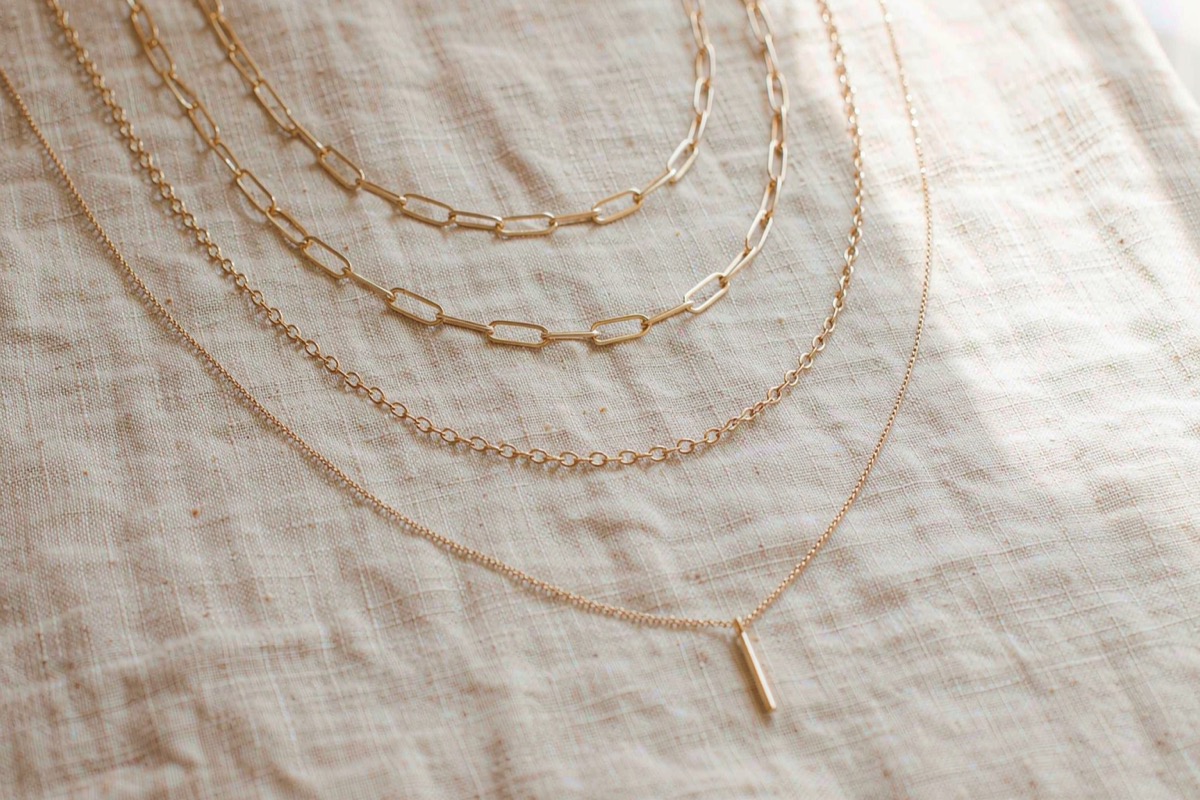
A tape measure gives the floor for the short end. A 14-inch choker cannot close flat on a neck that measures more than that, and a chain barely wider than the neck will dig rather than hang. For the long end, the best data point is a chain you already own: put it on, note where it rests, and compare that resting point to the chart. That single observation bundles your neck, your height and your posture into one calibration, which is worth more than any published guide.
Matching the length to the neckline
A crew collar sits at the base of the throat, so 14 and 16 inch chains disappear under it. Twenty inches clears the fabric and stays visible; 18 is the borderline — it clears a shallow crew and hides under a high one. Length that lives against fabric also changes upkeep, and the difference between sterling and fine silver is a good example of that split.
A chain that follows a V-neck reads as part of the garment’s line rather than an interruption. Eighteen to 20 inches puts a pendant inside the V, and the drop should end at or just past the point of the V — not float halfway up the opening, where it catches on nothing and looks undecided.
Off-shoulder, strapless and boat necks expose the collarbone area, which is why the shortest lengths belong there: 14 to 16 inches sits inside the exposed band and keeps the metal on skin. Longer chains fall onto fabric below and give up the placement advantage.
High collars and turtlenecks invert the problem. Everything above the sternum is covered, so the realistic options are skipping the necklace or going long enough to finish on the knit below the collar. A button-front shirt worn one button open makes a narrow slot: a chain resting at the collarbone sits against placket fabric on both sides, and only the pendant shows.
Chain profiles change how a length wears
Two chains of identical length can wear differently because of their profile. A flat curb lies against the skin as a single band and adds almost no visual height. A rope twists as it hangs, so it reads slightly shorter and catches light along its length. A box or snake chain keeps a clean line, and the snake in particular hugs the neck closely enough to read as a choker at lengths where a cable would hang.
Profile also decides what the chain survives. Fine, light links catch on knitwear, scarf fibres and coat linings; a heavier gauge resists snagging but pulls harder on anything threaded on it. The bail on a pendant has to pass over the link, so a small stamped bail fits a slim cable and refuses a chunky curb — a detail to check before the pendant goes on, not after.
Pendants change the math
A pendant turns a length question into a two-part measurement: chain plus drop. A small charm adds under an inch and barely moves the resting point. A larger focal piece can add two inches or more, and whether the combination ends above or below the collarbone decides whether it reads as a necklace or as a long pendant. If the focal piece is a pearl, grade it on lustre and nacre rather than on the extra drop.
Weight changes the picture too. A heavy pendant on a light chain drags the chain into a Y and can pull a collarbone length down toward the sternum. The chain’s gauge has to carry the focal piece without stretching, or the length you chose quietly stops being the length you wear.
Clasps, extenders and the last half inch
Most chains close with a lobster claw or a spring ring. The clasp adds no length, but it is the part that fails first: spring rings bend out of round, and a bent spring ring will not stay closed under the weight of a stack. A lobster claw is easier to operate one-handed and holds better on chains that carry a pendant.
An extender is a short chain segment attached behind the neck, and it shifts the resting point down by exactly its own length. Two inches added to an 18-inch chain make it a 20-inch one for placement purposes. Extenders also solve the layered-stack problem from the other end: instead of buying a third chain to fill a middle length, an extender on the shorter one can stretch into the gap. The trade-off is a second clasp at the back of the neck, which shows on an updo or a short haircut.
Layering without tangling
The spacing rule for stacks: keep at least 2 inches between adjacent lengths, or the chains braid into each other within an hour of wear. Two chains at 16 and 18 is the tightest usable pair; 16 and 20 is more forgiving. Three chains need a widening spread — 16, 18 and 22 keeps each gap at 2 or more inches. Vary the profile as well as the length, a thin cable at the collar and a heavier curb below it, and keep the finishes consistent so the stack reads as one object. Stacked silver also makes the storage rules non-optional, since chains heaped together tarnish each other; see how to store silver.
Two mechanics keep a stack wearable past the first hour. Weight should increase as length does, so the heavy chain anchors below and the light one stays at the collar. Stagger the clasps as well: three closures bunched at the same point behind the neck work against each other when you fasten them. Stored apart rather than heaped, each chain also keeps its own length honest for the next wear.
More in Jewelry
FAQ
- What is the most common necklace chain length?
- Eighteen inches. It sits at or just below the collarbone on most adults, clears a shallow crew collar, and works with or without a pendant.
- How far apart should chain lengths be when layering?
- At least 2 inches between adjacent chains. Sixteen and 18 inches is the tightest usable pair; three chains need a wider spread, such as 16, 18 and 22.
- Does a 20 inch chain fit over a crew-neck shirt?
- Yes. Twenty inches clears most crew collars and stays visible on the upper chest; 18 inches is the borderline length that hides under a high collar.
Second Look
Every figure used above, with the section it appears in. If a number here does not match the page you are reading, trust the page — and tell us.
- 24 inches
- Introduction
- 14 in
- Where each length lands
- 16 in
- Where each length lands
- 18 in
- Where each length lands
- 20 in
- Where each length lands
- 24 in
- Where each length lands
- 18 inches
- Neck size and height move the chart
- 16 inch
- Matching the length to the neckline
Tessa Marlow
Writes about garment construction, leather goods and footwear specs. Started in retail floor management before moving to editorial research. Our standards.