Sandal Sizing Runs on the Footbed: Why Open Footwear Fits Larger
Sandals are sized by the footbed, not the shoe last. Why open footwear runs large, how cork, EVA and leather footbeds differ, and when strap width wins.
Reviewed by Tessa Marlow · Updated Oct 12, 2026
What this answers
- Should I size up in sandals?
- Why does a cork footbed feel hard at first?
- Are EVA footbeds worse than cork?
A sandal’s size is the length of its footbed, not of a shoe last. No upper compresses the forefoot, no toe box holds a shape, and no leather pulls the foot into a standard silhouette. A foot in a closed shoe is constrained on four sides; a foot on a footbed only meets hard edges. Most sandal sizing confusion starts there.
Why open footwear runs large
Two effects stack. First, the metatarsals splay under load, and a sandal’s forefoot boundary is a fixed edge rather than leather that gives, so the spread shows up as overhang instead of disappearing into an upper. Second, feet swell during the day — podiatry guidance puts daytime expansion at roughly 5 to 8 percent, so the standard advice is to measure in the late afternoon or evening. A size that reads correct off a morning measurement can pinch by dinner.
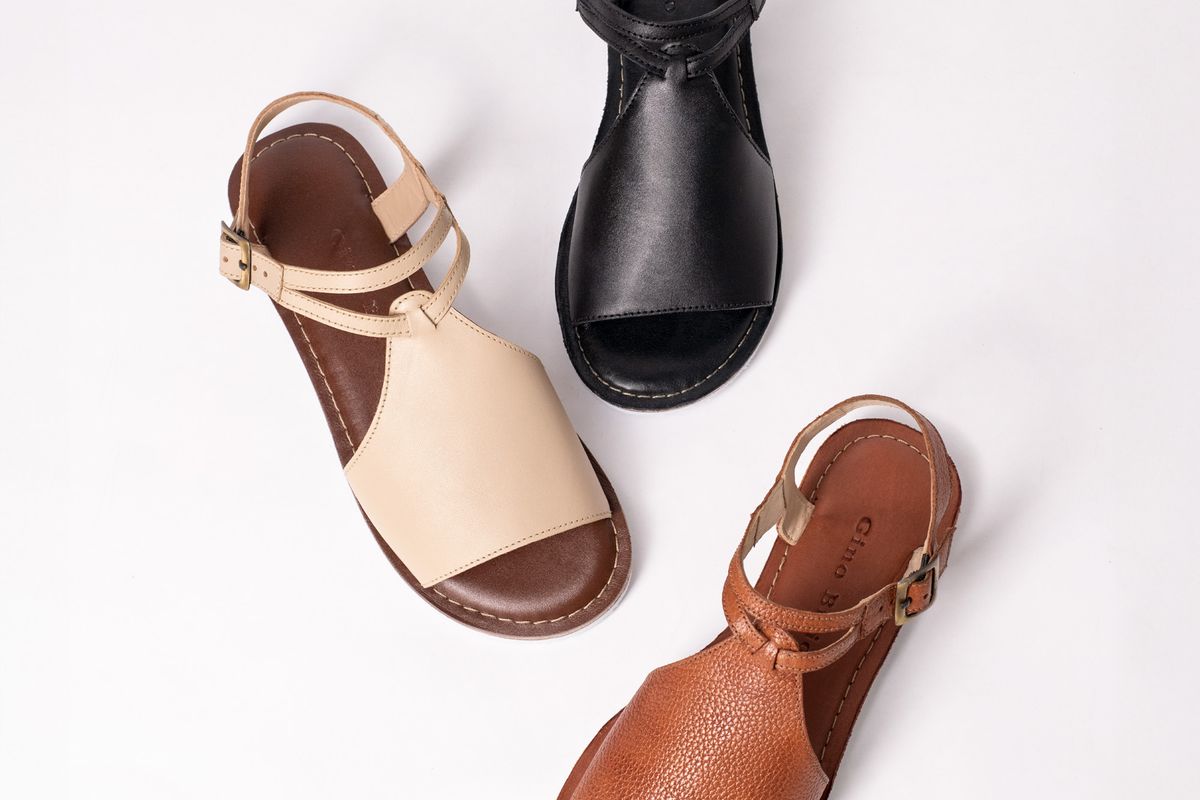
Brand charts encode this. Birkenstock’s fit guide asks for about 10 mm between the toes and the footbed edge and 5 mm at the heel, and its size calculator notes that feet expand slightly during the day, recommending the next size up when uncertain. That is the origin of the “size up half a size to a full size” rule of thumb.
What the footbed is made of
The footbed touches the foot all day, and the three common materials feed back into sizing differently.
| Footbed | Behavior | Fit consequence |
|---|---|---|
| Cork-latex | Insulating, well-cushioned, takes an impression of the foot over weeks | Starts snug, becomes custom; needs break-in; hates soaking |
| EVA | Waterproof, washable, light, shock-absorbent | Same fit on day one and month six |
| Smooth leather | Absorbs sweat, darkens with wear, conforms slowly | Relaxes slightly; needs cleaning and conditioning |
Birkenstock’s product copy describes cork as “insulating” with “very good cushioning,” and its EVA footbeds as “very light, highly elastic, shock-absorbent, waterproof” — washable and ultra-lightweight in the listed details. The trade is direct: cork buys a molded fit at the cost of break-in and water sensitivity; EVA buys waterproofing and zero break-in at the cost of a footbed that never becomes yours.
Strap width and the instep
Length is one axis; strap width is the other. A broad strap spreads pressure over more skin, while a narrow one concentrates load but follows the arch instead of bridging it — on a high instep, that difference is the whole fit. Buckles allow incremental adjustment: Birkenstock’s guide asks for roughly 5 mm of space under the lower strap and about 10 mm under the upper. Hook-and-loop trades fine adjustment for speed.
When to size up, and when to change width instead
Overhang at the toes and overhang at the sides are different problems. Birkenstock’s fit guide calls toe contact too small and side overhang too narrow, and it offers the original footbed in regular and narrow widths — a foot hanging off the side needs width, not length. A foot that slides without overhang is simply too long.
Cork complicates the first-week read: the size that feels right on day three can feel custom by week three as the core takes an impression — the official advice is to wear new sandals a few hours at a time and recheck the straps after a few days as uppers stretch. EVA skips that curve entirely.
Elsewhere the rule is the same — measure the body, not the letter: loafer last widths cover the width axis in closed shoes, size conversion between systems translates US, UK and EU numbers, and leather shoe care routine covers footbeds that will see rain.
More in Shoes
FAQ
- Should I size up in sandals?
- Often yes, but not blindly. A sandal is sized by footbed length, and an unconstrained foot spreads wider and longer than the same foot inside a closed shoe. When a brand's chart gives a range, fit to the larger measurement, then check the toe gap on the actual pair.
- Why does a cork footbed feel hard at first?
- The cork-latex core arrives rigid and takes an impression of the foot over the first weeks of wear. Birkenstock's fit guide advises wearing new sandals only a few hours at a time while the footbed and straps settle; sharp pain or numbness is a fit problem, not something to wear through.
- Are EVA footbeds worse than cork?
- Different, not worse. EVA is waterproof, washable and needs no break-in, and it never molds. Cork-latex is insulating, cushions well and forms to the foot, but it needs gradual break-in and should not be soaked.
Second Look
Every figure used above, with the section it appears in. If a number here does not match the page you are reading, trust the page — and tell us.
- 10 mm
- Why open footwear runs large
- 5 mm
- Why open footwear runs large
Tessa Marlow
Writes about garment construction, leather goods and footwear specs. Started in retail floor management before moving to editorial research. Our standards.