Belt Widths and Buckles: What Fits Which Trouser Loop
Belt width decides whether a strap threads your trouser loops at all. How to match width to loop, buckle to formality, and sizing to the hole you use.
Reviewed by Tessa Marlow · Updated Sep 19, 2026
The numbers first
- Width: 1.5 in (38 mm) · 1 3/10 in (33 mm) · 1.88 in (48 mm)
- Leather type: 10–11 oz vegetable-tanned English Bridle · Cowhide leather · Italian smooth leather, LWG Gold certified
- Price: USD 135 · USD 58 · USD 168
A belt’s width is decided twice: by the loops it must pass through and by how formal you want to look. A 1.5 inch strap often will not thread a suit trouser loop at all. Both constraints sit in plain sight, yet the width is the one specification buyers skip, because a listed inch number says nothing until it is held against the trouser it has to serve.
Width has to clear the loop first
Measure the usable inside opening of the loop, not its outer dimensions. A loop sewn to the waistband needs a millimetre or two of clearance beyond the strap on each side, or the strap binds and the belt refuses to slide when you thread it. Dress trousers have narrower loops than jeans, which is why crossover widths fail most: a strap cut for denim jams in a loop cut for worsted.
| Width | Best with |
|---|---|
| 1.25 in (32 mm) | Suits, dress trousers |
| 1.38 in (35 mm) | Business casual, chinos |
| 1.5 in (38 mm) | Jeans, weekend wear |
There is no universal loop standard, so check a 1.75 inch strap against your own trousers. The check takes seconds: lay the strap over the loop and look for daylight on both sides. A strap that fills the loop edge to edge will wear the loop’s stitching and look cramped even when it fits.
Loop construction on the trouser side explains the split. Dress trousers use narrow, thin loops cut from the same fabric as the waistband, and the fabric has no give. Jeans use wider, taller loops in heavier cloth, which is why a 1.5 in strap disappears into them. Chinos sit between the two, and a 1.38 in strap clears most of them, which is what makes that width the crossover compromise.
Where the tail goes after the buckle
A belt that fits leaves a tail long enough to pass the first loop and short enough not to crowd the second. The keeper, the fixed loop next to the buckle, exists to hold that tail flat, and a tail that runs past the second loop has nowhere left to go but outward. The result reads sloppy at the hip and catches on seatbacks and coat linings.
Tail length is a sizing outcome, not a separate feature. A strap closed on its middle hole leaves a balanced tail; the same strap closed on the tightest hole pushes the tip past the loops. Ratchet systems sidestep the problem by closing anywhere on the track, which is part of why they exist. For a prong belt, the tail is the visible report of whether the sizing method in the next section was followed, and it reads from across a room at a glance.
Leather thickness, ounces and the stiffness trade
Leather thickness is measured in ounces, where one ounce is roughly 1/64 of an inch, about 0.4 mm. Most belts are cut from 8 to 10 oz leather, so a typical strap runs 3.2 to 4 mm thick. The Tanner Goods Standard Belt is specified at 10 to 11 oz vegetable-tanned English Bridle, which puts it at the stiff end of the ordinary range and explains why the strap holds its shape out of the box.
Thickness is not a quality score on its own. A thick strap resists folding, which is what you want through the loops and what you pay for at the buckle fold, where a thin strap creases first. The same stiffness makes a thick belt slower to break in and less comfortable under a tucked shirt. Temper, the tannery’s word for how firm the leather feels at a given thickness, moves the result as much as the ounce number does, which is why two 9 oz straps can wear completely differently.
What the buckle does to the character
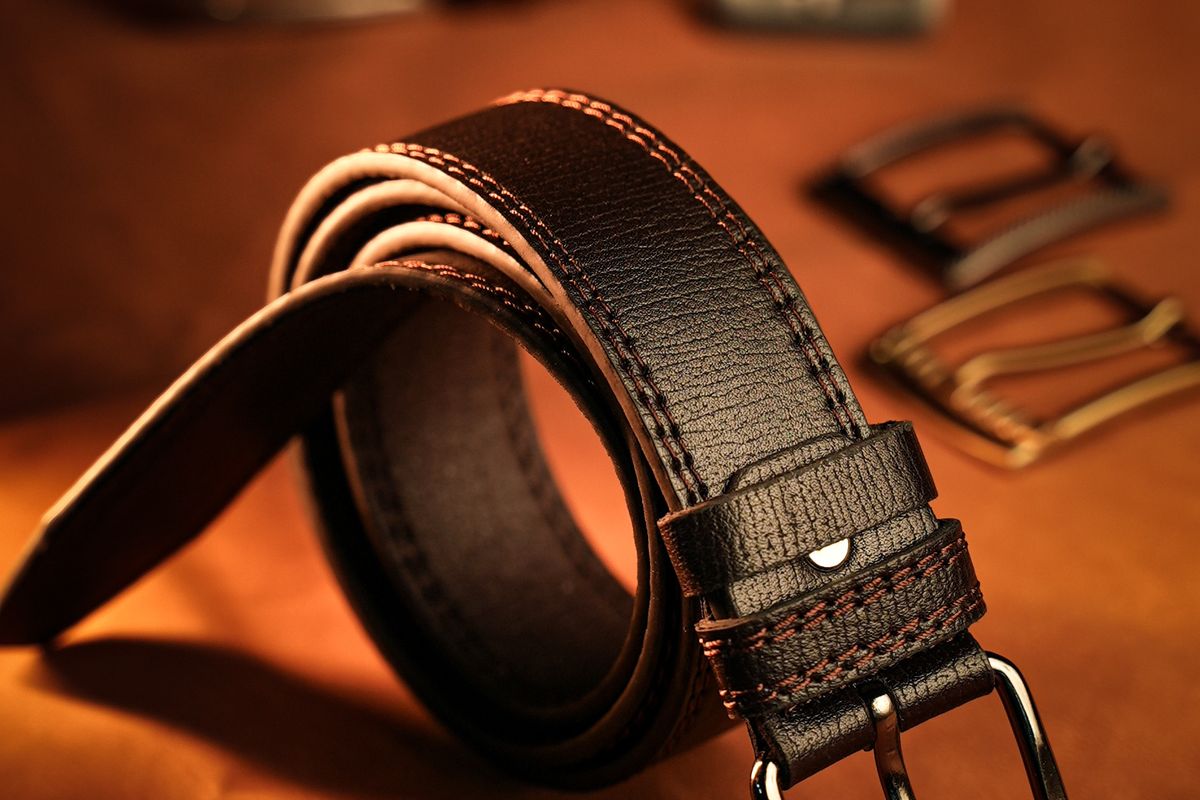
A single-prong frame buckle is the default for dress and casual alike: few moving parts, nothing to fail. The prong rides across the frame and drops into a hole, and the whole mechanism is visible and repairable. A roller buckle replaces the fixed centre bar with a rotating cylinder, cutting friction where the strap enters the frame, which reduces the abrasion the strap takes at the same stress point every day.
Hardware finish follows the same dress-casual line. The Tanner Goods Standard Belt ships with a nickel-plated roller-bar buckle and offers solid brass as an option, which is the workwear reading. The Madewell’s single-prong is gold-tone and the Cuyana carries its signature gold-tone buckle, both jewellery-adjacent finishes aimed at the same outfits as the narrower or cinched widths they sit on. Finish is a style decision with no functional content; buckle type is not, because the roller, the plate and the ratchet each change how the strap is gripped and how it can be altered later.
A plate buckle hides the catch behind a solid face and is built for appearance rather than grip. The strap attaches under the plate, usually by snaps, which makes the buckle swappable at the cost of a hinge or snap set that can loosen over years. A ratchet buckle uses a toothed track instead of holes and adjusts in small steps, which solves the between-holes problem but locks the strap into the track system: the belt cannot be shortened or re-holed the way a punched strap can.
Holes, spacing and the fit increments you get
Most belts carry five holes spaced about 25 mm apart, one inch, which has been the factory convention for long enough that a replacement punch is sized to it. Five holes at one inch of spacing gives two inches of adjustment in each direction from the centre hole, and each hole changes the effective strap length by a full inch.
That increment is coarse. Anyone whose waist sits between the inch marks ends up between holes, and a strap closed between its holes either gaps at the prong or stretches to reach the next one. Some dress belts space holes closer for finer adjustment, but the 25 mm standard is what to expect unless the listing says otherwise. This is also why the hole you actually use matters more than the belt’s stated size, a point spec sheets make about every measured product: the labelled number is a reference, the used position is the fact, and the two diverge quietly over the first month of wear.
Why “waist plus two” is only a starting point
Belt sizes normally measure from the buckle fold to the middle hole, not your waist, which is why the usual advice is two inches above your trouser size. Rise changes that figure: the same waist worn at the hip needs more length than worn high. The reliable method is to lay a belt you own flat and measure from the inner edge of the buckle to the hole you actually use, then buy that length. Between sizes, size up.
The same habit appears in sunglasses fit, where the lens width that matters is the one against your face rather than the one on the label. Both cases reward measuring the object that already works instead of deriving a size from a body number and hoping the brand’s convention matches.
When the strap is a size long
Because the quoted size lands on the middle hole, a strap that closes only on the tightest hole is a size long: the tail runs past the first loop and the buckle sits off-centre. A cobbler can punch one more hole nearer the tip, or shorten the strap from the buckle end so the existing holes and the tip stay as they are. Punching is the cheaper fix; shortening is the tidier one.
Shortening from the buckle end means unstitching the fold, trimming the strap and re-folding it around the buckle, which a belt with a stitched, not riveted, buckle fold tolerates well. The result keeps an even hole pattern and a tip that still tapers. Punching an extra hole leaves the length on the tail forever, so it suits a belt that is one hole too long, not two.
Full-grain, top-grain, bonded: read the edge
Full-grain leather is the whole outer surface of the hide with the grain intact, and it survives the two places belts fail: the buckle fold and the hole edges. Top-grain uses the same outer layer, sanded and refinished, so it wears well but develops less patina. Genuine leather is a split from the lower layers under a heavy coating, and it cracks at the holes sooner. Bonded leather is scraps glued to a backing.
The cut edge is the hardest thing to fake: full-grain shows dense packed fibre, a split looks fuzzy, and bonded leather reveals a fabric backing. Bonded also smells of plastic. The hole edges tell on the grade before anything else does, because a coated split cracks in a ring around each hole once the prong works the same spot for a season. Grade matters more than conditioning; leather care covers what helps.
Three belts across the width range
- Tanner Goods Standard Belt
- Madewell Medium Perfect Leather Belt
- Cuyana Wide Leather Belt
The Madewell sits at the narrow end at 1 3/10 in, which is what slim trousers and narrow loops want, and it is the only one sold by fixed length with a stated hip position. The Tanner Goods is the 1.5 in standard that fills jean and chino loops, sized from the buckle fold to the first hole with an order-one-size-up instruction. The Cuyana, at 1.88 in, is wider than most tailored loops accept, so it belongs to the cinched-waist uses where the strap rides over a dress or blazer rather than through trouser loops. It is also the only one of the three that publishes first and last hole positions for each size, which turns the tail-length question above into arithmetic instead of guesswork.
Recommendations
Some of the links below are affiliate links, which means we may earn a commission on qualifying purchases at no extra cost to you.
Pick 01
Tanner Goods Standard Belt
Best for denim and workwear USD 135
The Standard Belt is 1.5 inches of 10 to 11 oz vegetable-tanned English Bridle leather, which is the width most jeans and chino loops are cut for. It ships with a nickel-plated roller-bar buckle, and the roller matters because it cuts friction where the strap bends into the frame.
Works
- 1.5 in width fills jean and chino loops without crowding them
- Vegetable-tanned English Bridle leather, 10 to 11 oz
- Roller-bar buckle reduces wear at the strap entry point
Trade-offs
- Order one size up from your pant waist, and it may still need exchanging
- 1.5 in will not thread most suit trouser loops
Pick 02
Madewell Medium Perfect Leather Belt
Best slim belt on a budget USD 58
At 1 3/10 inches this sits at the narrow end, which is what slim trousers and high-waisted cuts want. Madewell sells it by fixed length rather than waist size and designs it to sit at the hip, so it is worth checking the length list before ordering.
Works
- 1 3/10 in width suits slim trousers and narrower loops
- Lowest price of the three at USD 58
- Sold in seven lengths from XX-Small to XX-Large
Trade-offs
- Designed to be worn at the hip, so it sits lower than a waist belt
- Cowhide grade is not specified beyond the leather content
Pick 03
Cuyana Wide Leather Belt
Best for a cinched waist 4.5 out of 5 · 15 ratings USD 168
At 1.88 inches this is the width that has to be checked against your loops first. Cuyana publishes the hole positions for each size, which makes it the only one of the three where you can work out the fit from the listing. Made in Italy from LWG Gold certified leather.
Works
- 1.88 in width holds a dress or blazer in place as a cinch belt
- Cuyana lists first and last hole positions for each of the three sizes
- Italian leather, LWG Gold certified, made near Pisa
Trade-offs
- Too wide for most tailored trouser loops
- Most expensive of the three at USD 168
Rating source: Cuyana product page, 15 reviews
Check current priceComparison
| Spec | Tanner Goods Standard Belt | Madewell Medium Perfect Leather Belt | Cuyana Wide Leather Belt |
|---|---|---|---|
| Width | 1.5 in (38 mm) | 1 3/10 in (33 mm) | 1.88 in (48 mm) |
| Leather type | 10–11 oz vegetable-tanned English Bridle | Cowhide leather | Italian smooth leather, LWG Gold certified |
| Buckle type | Nickel-plated roller-bar, solid brass optional | Single-prong, gold-tone | Signature gold-tone buckle |
| Sizing method | Sized buckle fold to first hole; order one size up from pant waist | Fixed lengths 35 in to 44 in by size, worn at the hip | XS / S-M / L-XL, with first and last hole positions listed |
| Price | USD 135 | USD 58 | USD 168 |
More in Accessories
FAQ
- What width belt goes with suit trousers?
- Dress trousers usually take 1 to 1.25 inches (25 to 32 mm). A 1.5 inch strap often will not pass through a suit trouser loop at all.
- Is belt size the same as waist size?
- No. Belt size measures from the buckle fold to a hole, not your waist. Waist plus two inches is a starting point, and rise changes the result.
- How can I tell full-grain leather from bonded leather?
- Look at the cut edge. Full-grain shows dense packed fibre, a split looks fuzzy, and bonded leather shows a fabric backing under a coating.
Sources
Second Look
Every figure used above, with the section it appears in. If a number here does not match the page you are reading, trust the page — and tell us.
- 1.5 inch
- Introduction
- 1.25 in
- Width has to clear the loop first
- 32 mm
- Width has to clear the loop first
- 1.38 in
- Width has to clear the loop first
- 35 mm
- Width has to clear the loop first
- 1.5 in
- Width has to clear the loop first
- 38 mm
- Width has to clear the loop first
- 1.75 inch
- Width has to clear the loop first
Tessa Marlow
Writes about garment construction, leather goods and footwear specs. Started in retail floor management before moving to editorial research. Our standards.