Strap Drop: The Number That Decides a Shoulder Bag
Strap drop, base width and loaded weight matter more than brand. Here is how to read those three numbers before you buy a shoulder bag online.
Reviewed by Tessa Marlow · Updated Sep 18, 2026
The numbers first
- Strap drop: 10.5–12 in / 27–30 cm, adjustable · 11 in / 28 cm handle drop · 8 in / 20.3 cm handle drop; 20 in / 51 cm crossbody drop
- Base width: 9.75 in / 25 cm exterior · 20.5 in / 52 cm exterior · 11 in / 28 cm at the base
- Material: 100% leather with microsuede lining · Italian pebbled leather · Leather, unlined
- Interior pockets: One internal pocket, 7 × 7.6 in, doubles as slip and zip · One internal pocket, 7.87 × 5.90 in · One interior patch pocket
- Price: USD 258 · USD 328 · USD 158
A shoulder bag either sits where you want it or it does not, and the number that decides this is strap drop — the distance from the highest point of the strap down to the bag’s opening. Most product pages hide it. When they do list it, it is usually measured on the shortest setting, which is rarely where you will wear it.
Why strap drop beats height
Bag height tells you how much fits. Strap drop tells you where the bag lands on your body. A 28 cm bag with a 20 cm drop sits under the arm. The same 28 cm bag with a 32 cm drop swings at the hip. Same capacity, completely different bag.
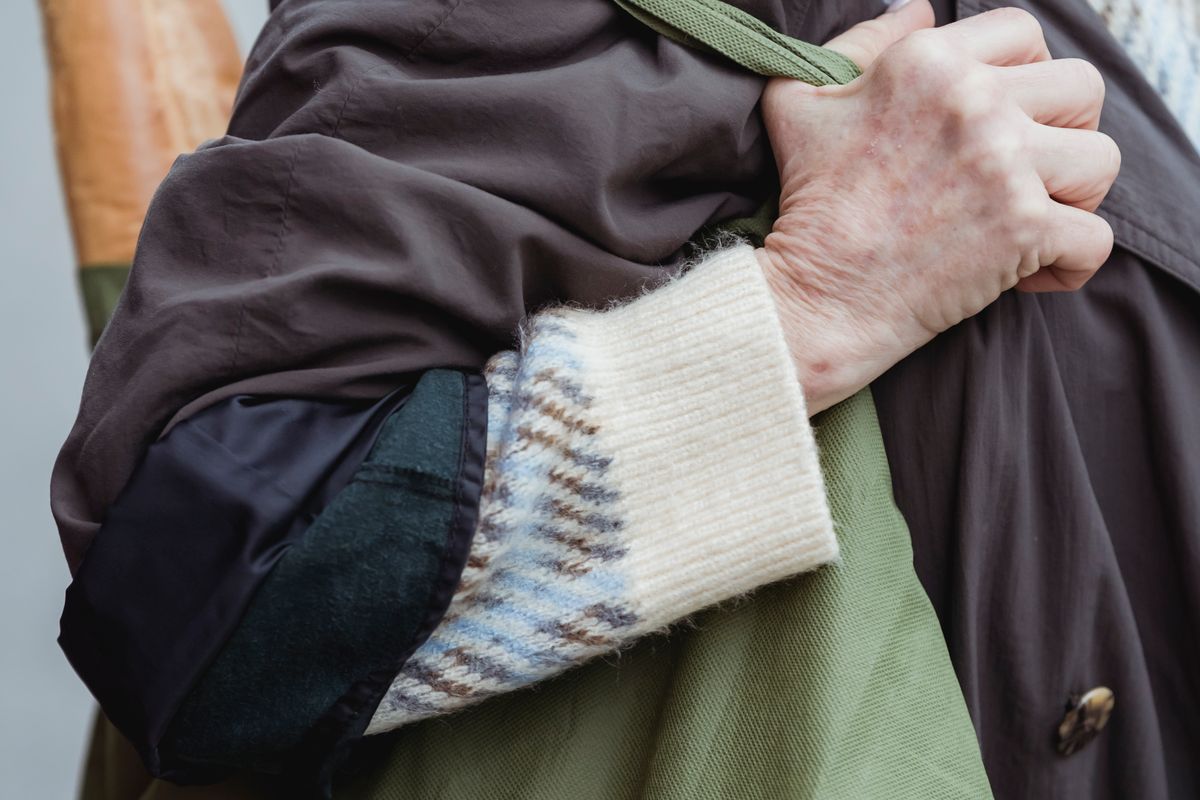
Drop is also the number that survives photography. Product shots are taken on models chosen to flatter the bag, often carrying it by hand or holding the strap in place with a raised elbow, and none of that is visible in the caption. A drop figure cannot flatter. It either clears your shoulder with the bag where you want it, or it does not, and two centimetres of difference is enough to move the bag from ribs to hip.
Drop is also a property of the bag, not the wearer, which is what makes it comparable across brands. Torso length and shoulder slope decide where any given drop lands on you; the figure itself does not change from body to body. That is why the reliable comparison is against a bag you already own rather than against a model in a photograph: the same 25 cm drop that sits under the arm on a long torso rides at the ribs on a short one. Once you know the drop of the bag whose position you like, every other listing becomes a subtraction problem.
Three drop ranges cover most carrying styles:
| Drop range | Where it sits | Best for |
|---|---|---|
| Under 20 cm | Tucked under the arm | Evenings, minimal carry |
| 22–28 cm | Just below the armpit | Daily commute |
| 30 cm and up | At or below the hip | Crossbody, heavier loads |
The measurement nobody publishes
Base width is the second number worth chasing. It decides whether a 13-inch laptop sits flat or leans, and whether a water bottle has any floor space left at all. If a listing does not state interior base width, treat the exterior width as an upper bound and subtract roughly 2 cm for structure and lining.
Base width earns its place because a leaning load changes the bag’s behaviour on the shoulder. A folder propped at an angle pushes its corner against the side wall, which stiffens the panel and shifts the bag’s centre of gravity outward. A bottle standing upright sits low and centred, where the strap wants the weight. The same bag carries both badly or both well depending on one number most brands round off to a single exterior figure.
What to check before you buy
- Interior base width, not exterior width
- Strap drop on the setting you will actually use
- Loaded weight after you add what you carry, not the empty figure
If a brand publishes only one number, make it the strap drop. Everything else can be estimated from photographs. This one cannot.
How straps adjust, and where the settings hide
The drop figure is usually the best of several settings, and the hardware decides how many there are. A buckle-and-hole strap adjusts across a wide range but lands only at discrete holes, spaced typically a few centimetres apart. A slider moves continuously but slips back under load unless the tail knots behind it. Fixed straps — common on structured bags — offer nothing, which makes the single published figure the only figure.
Punching extra holes in a leather strap works better for tightening than loosening, because the fold at the buckle end has spare leather in one direction only. It also weakens the strap at the new hole unless the punch is clean. Knotting a webbing strap shortens it safely but changes where the tail hangs. Whatever the mechanism, measure the drop at the setting you would actually use, then measure again with the strap loaded, because every one of these systems settles a little under weight.
Where the number shows up in practice
Drop is easiest to judge against bags you can already picture. A structured top-handle bag with a short strap usually lands between 10 and 15 cm, which puts it in the hand or the crook of the elbow. A medium shoulder bag in the 25 cm range sits just under the arm. A soft hobo with a 35 cm drop hangs at the hip and swings when you walk.
Two consequences follow. First, the same bag worn crossbody needs roughly 20 cm more drop than the same bag worn on one shoulder, so a strap that works one way will not work the other. Second, weight changes the answer: a bag that sits correctly when empty can slide down your arm once you add a laptop and a bottle, because the strap stretches and the bag’s own weight pulls it lower. If a listing gives a drop range rather than a single figure, the top of that range is usually measured on the longest setting, which is the number you want when you plan to carry anything heavy.
The measurement also decides whether the bag is comfortable to open. A drop under 20 cm means the bag sits close to your body and the opening is partly covered by your arm, so anything you need to reach often ends up in a side pocket instead.
Measure the bag you already carry
The five-minute measurement that makes every future listing readable: take the bag whose position you like, hang it as you normally wear it, and run a tape from the highest point of the strap down to the top edge of the body. That figure — yours, at your setting, on your shoulder — is the reference drop. Add the interior base width and the loaded weight you actually carry, and you have the three numbers this page keeps returning to, measured on equipment already proven on your body.
Write them down. A reference drop of, say, the figure your favourite commuter bag produces turns shopping into arithmetic: a listing at 3 cm less will sit noticeably higher, 3 cm more noticeably lower, and the range table above tells you which side of it the difference lands on. Without the reference, every product page starts the negotiation over.
Where the figure hides on a product page
Even brands that publish a drop disagree about what the word measures. Some measure from the strap’s highest point to the top of the body, some to the middle of the opening, and some print total strap length instead — a figure roughly twice the drop plus the width of the bag’s top, which reads larger and tells you less. Product diagrams usually reveal which convention is in use; a drop given without a diagram deserves suspicion.
Hardware adds its own ambiguity. A detachable strap’s drop should be measured from the attachment point, but clasps and rings can add or subtract a centimetre or two depending on where the brand starts the count. None of this is visible in a photograph. It is visible in two minutes with the tape, on the bag you already own, which is the argument for the reference measurement above.
Weight, stretch and the slow slide
Leather stretches under sustained load; webbing barely does. That single material difference explains why two bags with identical published drops behave differently after a month. A leather strap carrying a daily load of a few kilograms takes a set over time, adding a centimetre or more of drop that no spec sheet predicted. A nylon webbing strap holds its length and instead slides on the shoulder, which slick outerwear makes worse.
The fix differs by material. A leather strap that has stretched can be shortened a hole or re-punched; a sliding webbing strap wants texture, either a shoulder pad or a bag whose strap lining grips fabric. What both problems share is timing: neither appears in the store, both appear by the second week. Buying with the loaded weight in mind — the figure you computed, not the empty weight on the listing — is the only pre-purchase defence, since stretch and slide both scale with what you carry.
Three bags, three drops
Everlane The Studio Bag lists a handle drop of 10.5 to 12 in (27 to 30 cm) on a body 13 in high and 9.75 in wide. The top of that range clears a coat shoulder; the shortest setting tucks the bag high under the arm, which is the more stable of the two positions.
Cuyana Classic Easy Zipper Tote publishes an 11 in (28 cm) handle drop on a 20.5 in wide body. The drop suits shoulder carry; the width does not. A wide bag on a shoulder-length strap sits forward on the hip and swings more than the number alone suggests.
Madewell The Transport Shoulder Crossbody Bag carries an 8 in (20.3 cm) handle drop and a 20 in (51 cm) crossbody drop on the same removable straps. The short strap holds the bag high and tight; the long one changes the drop by more than 30 cm and turns it into a different bag.
Read together, the three make the case better than any rule of thumb. The Studio Bag’s range brackets the daily-commute band, so its adjustability buys real coverage. The Cuyana shows why drop alone is insufficient: a correct 28 cm drop still misbehaves on a body that wide. The Madewell shows what a removable-strap system is worth — two bags’ worth of behaviour from one purchase. The same arithmetic shows up in the 16-inch tote check, in interior width and loaded weight, and in how little room an under-seat bag leaves for strap at all.
Recommendations
Some of the links below are affiliate links, which means we may earn a commission on qualifying purchases at no extra cost to you.
Pick 01
Everlane The Studio Bag
Best drop for a coat shoulder 4.2 out of 5 · 156 ratings USD 258
A 13 in high leather bag whose handle drop adjusts from 10.5 to 12 in, which puts the top of the range just inside the 22–28 cm daily band. Snap closure rather than a zip, so the opening stays reachable while the bag is on the shoulder.
Works
- Adjustable 10.5–12 in drop covers both a tucked-under-the-arm and a below-the-shoulder carry
- Internal pocket 7 × 7.6 in doubles as a slip and a zip pocket
- Fits a 13 in laptop, so it works as a small work bag
Trade-offs
- The 9.75 in exterior width limits it to a slim laptop and little else
- Snap closure leaves the top open in rain
Rating source: Everlane product page, 156 reviews
Check current pricePick 02
Cuyana Classic Easy Zipper Tote
Right drop, wrong width USD 328
An 11 in handle drop is squarely in shoulder-carry territory, but it sits on a 20.5 in wide body, so the bag rides forward on the hip and swings. The hidden top zip is the reason to accept the width if you carry a laptop.
Works
- 11 in / 28 cm drop suits shoulder carry without holding the strap in place
- Top zip secures the main compartment
- Fits a 15–16 in laptop, so it doubles as a work bag
Trade-offs
- The 20.5 in width makes the bag swing at the hip more than the drop suggests
- At 1.6 lb empty it is heavier than the other two before anything is loaded
Pick 03
Madewell The Transport Shoulder Crossbody Bag
Two drops in one bag USD 158
Two removable straps give an 8 in handle drop for shoulder carry and a 20 in drop for crossbody, a swing of more than 30 cm on the same bag. The short setting is the one that lands the bag high and tight.
Works
- Two adjustable, removable straps cover shoulder and crossbody carry
- Top zip with an interior patch and an exterior slip pocket
- The lowest price of the three at USD 158
Trade-offs
- The 8 in handle drop sits above the 22–28 cm daily band and crowds the opening
- Price is listed by retailers rather than on the brand product page reached, and the crossbody strap has to be carried separately when removed
Comparison
| Spec | Everlane The Studio Bag | Cuyana Classic Easy Zipper Tote | Madewell The Transport Shoulder Crossbody Bag |
|---|---|---|---|
| Strap drop | 10.5–12 in / 27–30 cm, adjustable | 11 in / 28 cm handle drop | 8 in / 20.3 cm handle drop; 20 in / 51 cm crossbody drop |
| Base width | 9.75 in / 25 cm exterior | 20.5 in / 52 cm exterior | 11 in / 28 cm at the base |
| Material | 100% leather with microsuede lining | Italian pebbled leather | Leather, unlined |
| Closure | Snap | Top zip | Top zip, plus exterior slip pocket closed by a collar stud |
| Interior pockets | One internal pocket, 7 × 7.6 in, doubles as slip and zip | One internal pocket, 7.87 × 5.90 in | One interior patch pocket |
| Price | USD 258 | USD 328 | USD 158 |
More in Bags & Luggage
FAQ
- What is a good strap drop for a daily bag?
- Between 22 and 28 cm suits most people for a bag worn on the shoulder without holding it in place.
- Does strap drop change with the size of the bag?
- Yes, and that is the trap. Larger bags usually ship with longer straps, so a bigger bag can sit lower.
- Can a strap be shortened later?
- Sometimes, but punching new holes rarely matches the original spacing and can weaken the leather at the fold.
Sources
Second Look
Every figure used above, with the section it appears in. If a number here does not match the page you are reading, trust the page — and tell us.
- 28 cm
- Why strap drop beats height
- 20 cm
- Why strap drop beats height
- 32 cm
- Why strap drop beats height
- 25 cm
- Why strap drop beats height
- 30 cm
- Why strap drop beats height
- 2 cm
- The measurement nobody publishes
- 15 cm
- Where the number shows up in practice
- 35 cm
- Where the number shows up in practice
Tessa Marlow
Writes about garment construction, leather goods and footwear specs. Started in retail floor management before moving to editorial research. Our standards.