Ankle Boot Shaft Height and Calf Fit in Centimetres
Shaft height is measured from the heel seat, not the floor, which is why listings disagree. How to read shaft and ankle circumference before you buy.
Reviewed by Tessa Marlow · Updated Sep 9, 2026
The numbers first
- Heel height: 70 mm, published by the brand · Brand publishes sole height 32 mm, no heel figure · About 25 mm, from a retailer measurement
- Upper material: Cow leather; some colourways add a stretchy synthetic shaft · 100% Smooth leather · Oiled nubuck leather with GORE-TEX
- Price: EUR 160 · USD 180 · USD 200
Boot listings disagree about shaft height because there is no single measuring convention. The number that matters runs from the heel seat, the point at the back where the heel meets the ground, straight up to the top of the collar. Listings measured from the floor quietly add the heel height, which is why one boot appears as 120 mm here and 145 mm there. Until you know which convention a listing used, the figure on the page is a guess wearing a unit.
What shaft height changes
Shaft height decides two things: whether the collar sits on your ankle bone or above it, and what your trouser hem does. A shaft under roughly 130 mm usually sits at or below the ankle bone, so a straight hem passes over it. Past about 200 mm the collar is clear of the ankle and the hem must go over the shaft or sit on top of it. Between those figures a hem catches on the collar every step.
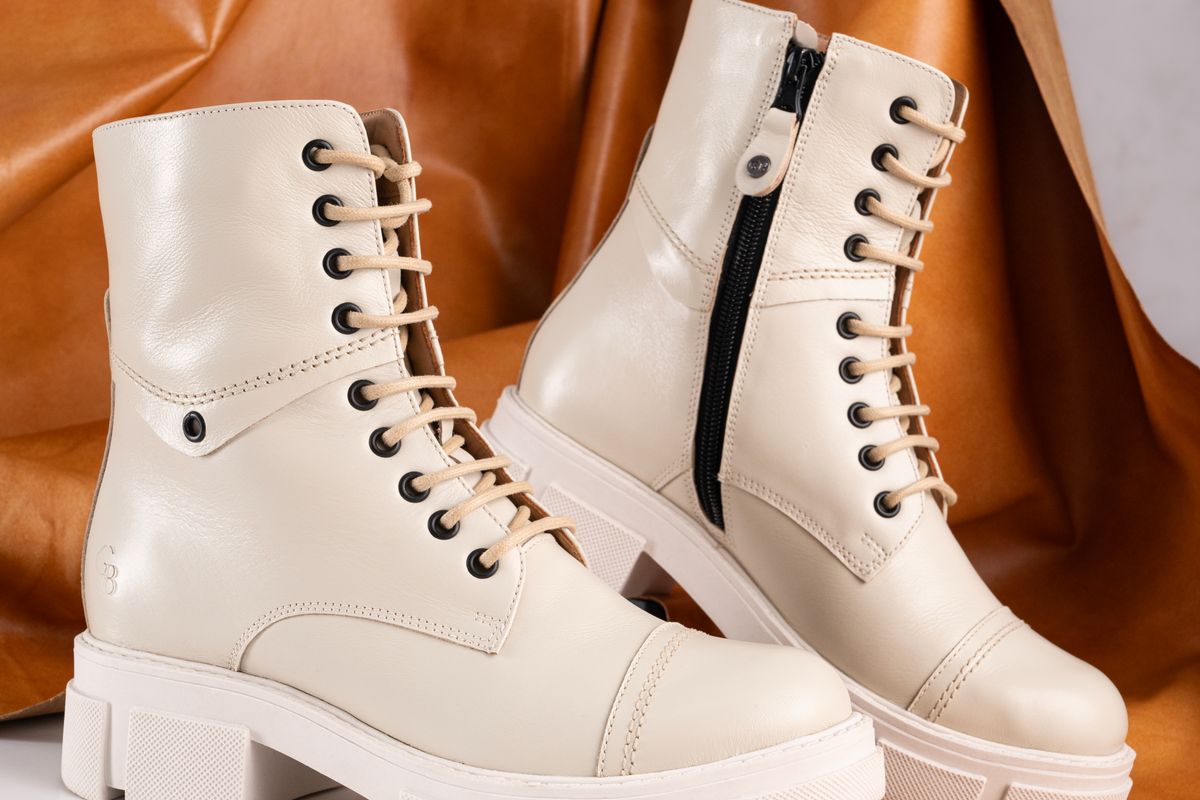
That is a tendency rather than a rule, because hem width and how you wear the trouser matter as much as the number. It is still the most useful figure on the page, and the reason spec sheets reward the measurements brands omit.
Ankle circumference decides the zip, not calf circumference
For an ankle boot the relevant measurement is the ankle, not the calf. A zip closes comfortably only when the shaft circumference clears your ankle bone with something to spare. If your ankle measurement is close to the published shaft circumference, the zip will close but the seam will sit under tension and press inward across the bone. The boot fits, and it hurts.
Brands that publish shaft width give you the number to compare against a tape measure around your ankle. Most do not, which pushes the decision onto how the boot is built rather than how it is sized.
How to measure your own ankle for a shaft
Sit down with your foot flat and wrap a soft tape around the widest point of the ankle, passing straight over the bone. Wear the socks you plan to pair with the boots, because a heavy boot sock can eat most of the slack a close-fitting shaft leaves you. Measure both ankles while you are at it: the two rarely match exactly, and the shaft has to clear the larger one. Ankles are also larger at the end of a day spent on your feet, so an evening measurement is the conservative one.
Compare that figure against the opening circumference whenever a brand publishes one. The gap you want is small but real, enough for the zip to run without dragging and for the seam to sit beside the bone rather than on it. If the boot you are considering rises past the ankle toward the calf, repeat the measurement at the height the collar would actually sit, with your foot flat. The calf muscle changes shape when the ankle flexes, and a shaft measured on tiptoe flatters nobody.
Leather gives in width and barely in length
Leather has more stretch across the hide than along it. A shaft slightly narrow through the ankle often settles over a few wears, particularly where the gore or the lacing takes up the slack first. A shaft too short at the collar will not get taller, because nothing you wear on your foot adds height to a seam that already sits where it sits. This is the same asymmetry that decides how a loafer last behaves: the material gives where it can, and nowhere else.
The direction of the stretch also matters. Width gives at the points of greatest bending, which for an ankle boot is the line across the front where the shaft flexes with each step. The collar seam, stitched and often reinforced, is the last place any give appears.
Elastic gore versus a full zip
A full-length zip fixes the shaft circumference at one value and changes it only by how far the zip closes. Elastic gore does the opposite: the opening moves, so one boot accepts a range of ankles. For a wider ankle the gore is usually the better answer, and a boot combining both gets the easy entry of the zip and the tolerance of the gore.
Each closure has a failure mode of its own. A zip slider is a wear part; once it stops holding, the boot opens under load no matter how well the shaft fit. A gore is a rubber-and-textile panel stitched into leather, and an aged one relaxes instead of gripping, which turns a once-snug opening into a loose one. Gore also sits against the skin on most chelsea builds, so the panel’s width, not just its stretch, decides how the collar feels over the bone.
Published shaft figures are tied to a reference size
A shaft number in a size chart is not a promise for every size in the range. Vagabond publishes a 209 mm shaft height and a 247 mm opening width for the Hedda, but both figures are tied to a stated reference size of 37, and the same boot graded up to a size 41 will not keep identical dimensions. Treat a published figure as the value at one point in the range and expect it to move with size, in a direction the listing rarely states.
Heel and sole heights carry the same caveat. Dr. Martens publishes a 32 mm sole height for the 1460 and no heel figure at all; the ECCO Soft 7 Tred shows about 25 mm at the heel from a retailer measurement rather than the brand page. The heel-seat convention is what keeps these numbers honest. Because shaft height starts where the heel meets the boot, the collar height on your leg does not change just because a sole is thick; what a thick sole changes is how a floor-measured listing inflates the figure.
When the listing omits the shaft
Then the workarounds. Retailer measurements are the most common substitute: one retailer lists the 1460 at about 165 mm, and the roughly 120 mm shaft on the ECCO Chelsea also comes from a retailer rather than the brand. A retailer figure is usable, but it is a second party’s tape, so treat it as an estimate with a tolerance you cannot see. Laced boots are the other escape hatch. An 8-eye lace-up adjusts continuously, so a missing opening circumference matters far less than it would on a zip.
What does not work is estimating from photographs. The angle hides whether a collar sits above or below the bone, and a boot photographed on a foot a size different from yours proves nothing. If no number surfaces anywhere, the honest options are to ask the brand directly for the shaft and opening measurements or to buy from a seller whose returns cover a fit miss.
Three ankle boots, three measurements
Vagabond Hedda is the only one of the three whose brand publishes shaft height, shaft width and heel height together, which makes it the easiest to check against a tape measure before ordering. The trade is a 70 mm flared heel and a shaft the brand lists at 247 mm around the opening, so it is a poor match for a wide ankle.
Dr. Martens 1460 laces rather than zips, so the opening adjusts continuously — the practical advantage of a lace-up over any fixed closure. Shaft height is not published, though the brand states its welted lines are heat-sealed and reinforced with the signature welt stitch.
ECCO Soft 7 Tred GTX Chelsea adds GORE-TEX waterproofing and pairs the zip with chelsea gore, so the opening tolerates more ankle than the zip alone allows. Its shaft figures come from retailer measurements rather than the brand page — exactly the inconsistency worth budgeting for.
The linings change how the same collar height feels rather than where it lands. The Hedda pairs its leather upper with a Tencel textile lining and a chrome-free leather insock, which is the smooth, cool combination against skin. The ECCO’s oiled nubuck carries a GORE-TEX membrane the brand names as 100% waterproof, and a waterproof shaft also holds warmth, so the identical collar reads warmer on a February platform than an unlined one. The 1460’s smooth leather is stiff to begin with and breaks in slowly, which is a fit fact of a different kind: the opening that laces comfortably on day one is the one it keeps.
What a wrong guess costs
Too tall is mostly an aesthetic problem; the collar looks different than you planned and the hem sits differently. Too short at the collar has no fix, because leather does not gain length. Some cobblers will shorten a shaft instead, but a zip or a gore panel limits where the cut can go, and that surgery costs more than the difference between two sizes of the same boot.
Too narrow around the ankle is the worse failure. A zip that closes under tension presses the seam into the bone with every step, and the modest width stretch leather offers rarely rescues a 20 mm shortfall. The cheap insurance is the tape measurement in the section above, taken before the order rather than after the return label.
One more habit closes the loop: keep the listing open while you measure, and write the published figure next to your own before deciding. The comparison takes a minute, survives a sale page’s photography, and turns an ankle boot purchase from a bet on convention into a check against two numbers that both came off a tape. Where the two disagree by a wide margin, the listing’s measuring convention is the first suspect and the retailer’s tape is the second.
Recommendations
Some of the links below are affiliate links, which means we may earn a commission on qualifying purchases at no extra cost to you.
Pick 01
Vagabond Hedda
Best for a dressy ankle boot EUR 160
The brand lists shaft height (209 mm), shaft width (247 mm) and heel height (70 mm) against a stated reference size of 37, which makes it the easiest of the three to check against a tape measure before ordering. The trade is a 70 mm flared heel and a narrow opening, so it is a poor match for a wide ankle.
Works
- Shaft height, shaft width and heel height all published, based on size 37
- Chrome-free leather insock and Tencel textile lining listed by material origin
- Sizes 35 to 42 across every colourway
Trade-offs
- 70 mm flared heel is high for a long commute
- Brand lists shaft width at 247 mm, which is narrow, and no wider version is offered
Pick 02
Dr. Martens 1460
Best when shaft height is unknown USD 180
An 8-eye lace-up boot, so the opening adjusts continuously instead of being fixed at one circumference the way a zip is. The collar sits above the ankle, and the brand states its Goodyear-welted lines are heat-sealed and reinforced with the signature welt stitch.
Works
- Lacing lets the shaft tighten or loosen across a range of ankles
- Goodyear welted with a replaceable PVC air-cushioned sole
- 100% leather upper; sole height published at 32 mm
Trade-offs
- Shaft height is not published, so the number has to come from a retailer
- Smooth leather is stiff to begin with and breaks in slowly
Pick 03
ECCO Soft 7 Tred GTX Chelsea
Best for wet weather USD 200
A chelsea boot with a GORE-TEX membrane, so the upper is waterproof rather than merely water-resistant. The inside zip handles entry and the chelsea gore gives the collar room to move, which matters more than shaft height when the ankle is wide.
Works
- GORE-TEX membrane, and the brand names it as 100% waterproof
- Oiled nubuck leather made by ECCO Leather (the brand owns its own tanneries)
- Zip plus elastic gore accepts a wider range of ankles than a zip alone
Trade-offs
- Shaft height and heel height are not on the brand page, only in retailer listings
- Highest price of the three and the heaviest construction
Comparison
| Spec | Vagabond Hedda | Dr. Martens 1460 | ECCO Soft 7 Tred GTX Chelsea |
|---|---|---|---|
| Shaft height | 209 mm, published by the brand, based on size 37 | Not published by brand; one retailer lists about 165 mm | About 120 mm, from a retailer measurement |
| Heel height | 70 mm, published by the brand | Brand publishes sole height 32 mm, no heel figure | About 25 mm, from a retailer measurement |
| Upper material | Cow leather; some colourways add a stretchy synthetic shaft | 100% Smooth leather | Oiled nubuck leather with GORE-TEX |
| Closure type | Inside zip | 8-eye lace-up | Inside zip plus chelsea elastic gore |
| Width options | None; one shaft width per style | None; single width | None; single width |
| Price | EUR 160 | USD 180 | USD 200 |
More in Shoes
FAQ
- How is boot shaft height measured?
- From the heel seat — the point where the heel meets the ground at the back of the boot — straight up to the top of the collar. Measuring from the floor adds the heel height to the figure.
- Why does a boot zip close but still feel tight?
- A zip needs the shaft circumference to clear your ankle bone, not just to meet it. Leather has little give around the ankle, so the zip closes on tension rather than slack and the seam presses inward.
- Will leather boots stretch to fit my calf?
- Width gives a little and length barely gives at all. A shaft that is 20 mm too narrow may settle; one that is 20 mm too short at the collar will not get taller.
Sources
Second Look
Every figure used above, with the section it appears in. If a number here does not match the page you are reading, trust the page — and tell us.
- 120 mm
- Introduction
- 145 mm
- Introduction
- 130 mm
- What shaft height changes
- 200 mm
- What shaft height changes
- 209 mm
- Published shaft figures are tied to a reference size
- 247 mm
- Published shaft figures are tied to a reference size
- 32 mm
- Published shaft figures are tied to a reference size
- 25 mm
- Published shaft figures are tied to a reference size
Tessa Marlow
Writes about garment construction, leather goods and footwear specs. Started in retail floor management before moving to editorial research. Our standards.